I was scrolling Instagram this morning, trying to wake up (my children don’t believe in waking up at a human hour), when I saw a guru post: “What I would declutter if I was at your house for 4 hours.” My friend… if I had four hours at my house to declutter, I’d declutter forty houses.
I know this may come as a surprise for the non-parents amongst us, but parents do not have four hours. I barely have a few minutes to eat some bites before the toddler is out of their seat and the older siblings are arguing about who looked funny at who. Four hours? Four hours?!
Whew…now that I got my venting out of the way, let me share some decluttering tips that are actually helpful for busy parents. In writing this post, I also searched online for advice and between the “mindful journaling,” the “fierce” group coaching, and two-hundred-page-PDFs helping me decide if the spatula brings gratitude, I realized that decluttering tips for parents assume you have a free weekend, a clear head, and nobody under four feet tall demanding a snack (even though you just made dinner). The reality is you have ten minutes (maaaaybe fifteen minutes). But ten minutes to declutter is plenty if you know where to start.
The biggest issue parents have when trying to declutter is that we are stuck on the “where do I even start?” question. It’s not laziness and it’s not a lack of knowing how to declutter, but it’s that overwhelming feeling that the house is a complete mess and you don’t know where to start and you get action paralysis.
The Rules
First: pick a job you can abandon. Set a time and set your expectations. Marathon declutter sessions are how you get burned out and swear off decluttering until next spring (and your room is full of junk that is now strewn everywhere). So right now, pick the one place that needs to be decluttered that you can declutter in ten minutes and you can abandon and come back to anytime to quickly finish.
Second: focus on one small zone, not a room. A drawer, a shelf, a counter, a single basket – something that you know needs to be decluttered, and you can reasonably finish in a few minutes. If it’s too big, shrink the zone – any progress is good progress. For example, the “kitchen” is not a zone; “the drawer where batteries go to die” is a zone. You want your declutter to be effective so pick a zone where your ten minutes makes a difference.
Third: nothing you remove stays in the house. Trash leaves today, and donations go in the trunk or out of the house. It’s a way to have closure and a positive result (and you will mentally feel like you can take a breath).
Fourth: declutter first, organize and clean later (much, much later). I am going to tell you this over and over again, and if you find yourself wondering, remember my words: you DO NOT need bins, baskets, or label makers today. Organizing doesn’t remove anything – organizing just rearranges what you already have, so you end up rearranging clutter and possibly adding more clutter under the guise of “organizing.” I did sneak in cleaning under this rule – when I tried to declutter purposefully, I found myself distracted by actually cleaning the home (this may yet again come as a surprise to the non-parents in the audience, but homes with little kids have big messes). Try to focus on the declutter part where you remove objects that are clutter. The cleaning and organizing is for another day.
The Playbook
1. Pick either the easiest spot you can declutter or the spot you’re most frustrated with
Start by picking a spot you can declutter in 10 minutes.
For example, can you declutter the closet with all the outgrown, out of season clothes? If you can’t declutter in 10 minutes, you can declutter some clothes OR you can think of the next easiest spot. Can you declutter the paper drawer and old mail? If you can’t declutter in 10 minutes, you can declutter some papers OR you can think of the next easiest spot. Can you declutter the mudroom or shoe closet? Can you declutter the makeup drawer? Can you declutter the craft cabinet? Can you declutter the pantry? I know it’s repetitive but our homes are all different and we will start in different places. Pick what fits the 10 minutes, accept a partial declutter or think of the next easiest spot.
Think of it like a snowball effect: one cleared space makes you want to clear the next, and the momentum builds on its own. If you really can’t decide, open the nearest drawer, because I guarantee you it will have something in it that doesn’t belong and you don’t need.
2. Have three bags with you
I cover this in my Minimalist Parenting Guide in more detail, but you need to have a trash bag, a donation bag, and a maybe bag. Sort each item in the zone according to these three bags. When you are done, the trash goes to the trash (do not second guess yourself!), the donation bag goes in your trunk to donate later (do not second guess yourself!), and the maybe bag goes out of sight (somewhere where you only have access) to it to deal with later (if you have a maybe or unsure bag you don’t have to make the hard calls today but you have made some progress).
For example, when I clean my pantry or makeup cabinet, I don’t usually need a donation bag because it’s either expired items or used makeup. When I declutter my kid’s toys, I mostly use the maybe or donation bags and keep them out of sight for very good reasons. Which brings me to the next and last item.
3. The quick declutter is just for you (for now)
Involving your kids in decluttering has its place and there are ways to engage in an age-appropriate way, but this isn’t it. Ten minutes is productive only if you’re moving fast, and you don’t have the time to debate why the rock from the Target parking lot is super special (it’s always rocks or sticks or a broken down something of questionable origin, sigh).
When you want quick results, make the easy calls yourself and save the kid-friendly sorting for a time when you can slow down. Remember how I said earlier that actually starting and decision paralysis overwhelm parents? By focusing on small wins and making progress, you build the confidence and skills to deal with clutter in a way you can later teach to your children.
4. The quick Do’s and Don’ts
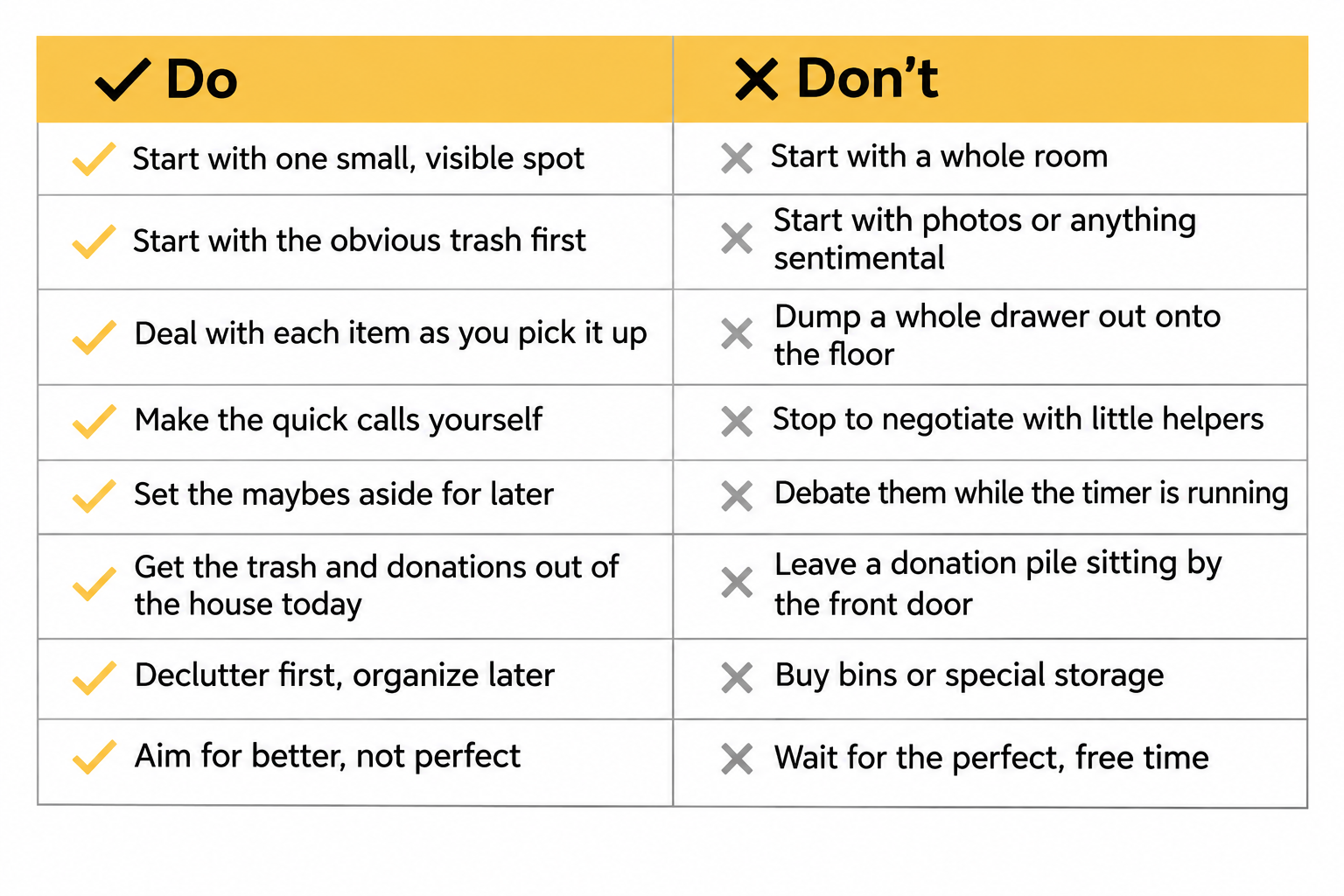
The Reality Check
Ten minutes will not fix your whole house. It will definitely not make your home Pinterest-aesthetic ready, and you shouldn’t expect it to. What a short declutter session fixes is the “getting started” challenge. And the starting problem is the thing that’s kept most of us stuck for months (or years).
Once you’ve proven to yourself that you can clear one basked, one drawer, one counter, one closet, one hallway, and eventually one room, without losing a weekend or your sanity, decluttering and minimalism stop feeling impossible. It’s just a series of small, boring, doable wins that make a difference and remove the “barriers” you experience daily. Eventually, there is a space and time for doing that four hour declutter where you take whole rooms and sections out, but those types of declutter have to be carefully considered and scheduled ahead of time or you end up with bigger mess and bigger overwhelm.
Minimalism with kids isn’t about owning less for the sake of it. It’s about having less in the way, so you have the time, presence, and clarity to focus on what matters (because parenting is hard enough already).
Want the Full System?
If you want a more structured approach, the full Minimalist Parenting Guide walks you through simple systems for toys, clothes, gear, paper, and more, built for busy parents who don’t have hours to spare on philosophizing and journaling about inner calm (and big thank you here for everyone who shared tips and updates on how the Guide is helping, always mind-blowing of the connections we make in such a small community).